
I’m Going Blind
Are we there yet?
Prologue
I’m going blind.
“Going blind.” An odd phrase, isn’t it? It sounds like I’m traveling a well-worn path toward some old, familiar destination. But nothing could be further from the truth. If it were really that simple, the journey would be less arduous and a bit easier to bear.
In his book Country of the Blind, Andrew Leland suggests that the phrase “becoming blind” is more apt. I agree. The truth is that no one on this trip knows precisely what route it will take, how long it will last, or exactly what the final destination will look like—if it looks like anything at all. As with all things biological, becoming blind is different for everyone.
My journey began several years ago. Family history warned me that I might take the trip, but not when it would start. Things moved slowly at first. But over time, they picked up speed. Along the way, there were brief periods during which nothing seemed to change. These were just long enough for an optimistic denial to set in. Then each ended abruptly with some small but noticeable visual glitch that yanked me back to reality.
Eventually, I had to admit that—legally speaking—I was blind, despite the fact that I still had some residual vision. That was a tough day.
The journey, which is unrelenting, unpredictable, and inexorable, has not been deterred by five surgeries and a fistful of eyedrops. It simply grinds on, demanding that I redefine every movement, relearn every daily task, and reevaluate every experience. Without asking my permission or considering my feelings, large swaths of my life have melted into fading remembrances of the last time they were perceived: the cherished faces of my children, my garden, the pages of my favorite antique books, and—quite eerily—my own reflection in the mirror.
Despite these disruptions, however, some aspects of my life have been more compliant. For instance, my teaching and research have been only moderately inconvenienced, thanks to technology and a cadre of uniquely supportive students, none of whom mind that I recognize them by voice rather than sight, or that they need to announce themselves when they stop by my lab to chat.
Then there is my son. I could not ask for a stronger, more supportive relationship. It was much different when I was the son.
My Father
My father began losing his sight when he was a young man. I don’t remember many of the details. Unfortunately, he and I were not very close, though I always wished we were. He didn’t talk to me much—especially about personal things. All I knew about his vision was that his schoolmates made fun of his thick glasses, and that, as an adult, he needed both contact lenses and bifocals to coax his vision into the near-normal range. Unfortunately, corrective lenses cannot stop the inevitable.
I remember him having two eye surgeries when I was in high school. They may have been for cataracts. I think they helped him a little bit, but they could not save his failing vision.
I never quite understood what was causing my father’s vision loss. I’m not sure he did either. But based on how he explained it, I think it was hypermyopia, a progressive condition that can lead to retinal detachment. However, he also had glaucoma. That’s the condition that’s stealing my vision.
By the time my father retired, he had precious little vision left, and soon even that was gone.
Some years later, in a rare and unguarded moment of vulnerability, he told me about a morning ritual he used to perform. As soon as he woke up, he’d wave his hand back and forth in front of his face. For a while he could see each of his fingers in silhouette, and he’d say to himself, “Well, at least I can still see my hand.” Then, when his hand melded into a mitten-like shadow, he’d say to himself, “Well, at least I can still see movement.”
“Then,” he said, “one day, it was all gone.”
He sat quietly for a moment, then got up, walked into the den, sat down in his recliner, and turned on his radio. Tears welled up in my eyes.
Now, I have my own morning ritual.
It’s Not for Profit
My father’s struggle with vision loss, having two cousins who were blind, and my work as a special-needs teacher drew me into the fields of vision research and assistive technology. That’s why I founded my not-for-profit startup, Haptic Insight.
It all began about ten years ago in my basement. I was frantically trying to teach myself electronics and computer programming in order to find a way to replace lost vision with touch. I had already spent two decades studying and teaching animal and human sensory perception, so I had an intuition that this could work.
At the time, others were working on similar problems, but none of the solutions felt practical to me. Someone even invented a device that delivered patterns of electric shocks to the tongue, supposedly to represent the locations of objects in the world. I don’t know about you, but walking around with a cord hanging out of my mouth while my tongue is being shocked doesn’t seem like a practical answer to vision loss.
I did have one advantage: I’m a psychologist and a former special-ed teacher, so I approached this challenge from a human perspective rather than a purely engineering one. I wasn’t trying to build a flashy gadget. I was trying to build something people would actually want to use in daily life. I wanted something intuitive. Something that respected how people move through the world. Something that could reduce collisions, reduce uncertainty, and maybe reduce a little of the stress that comes with navigating unfamiliar spaces without reliable sight.
That goal is what still drives me. Not novelty for novelty’s sake, and not technology for its own sake—but practical, humane design. If a device isn’t usable, it isn’t helpful. And if it isn’t helpful, it won’t matter how sophisticated it is.
That’s been the central lesson of my work: when vision fades, dignity matters; when mobility is threatened, confidence matters; and when people are forced to adapt, the tools we give them must meet them where they are.
The Grand Irony
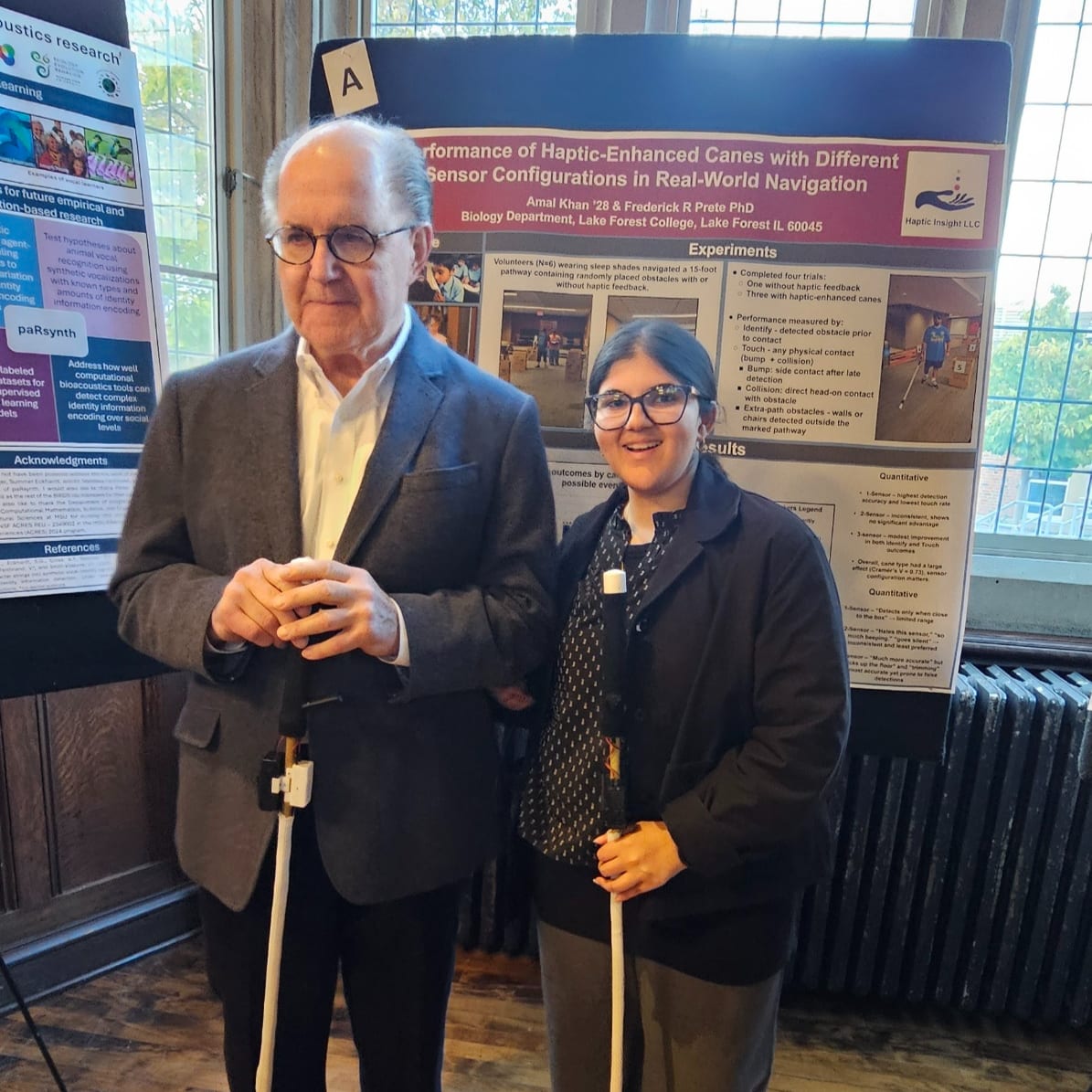
As my research progressed, one project began to show great promise. It was a haptic-enhanced white cane that warns the user with a gentle vibration when the cane tip gets close to an obstacle (patent now pending). In other words, it gives the visually impaired user a “heads up” before they collide with something, or someone. Although some other technologists had tried to do something similar, our approach was significantly different in both construction and performance.
Then came the coincidence of two events… one good, and one not so much.
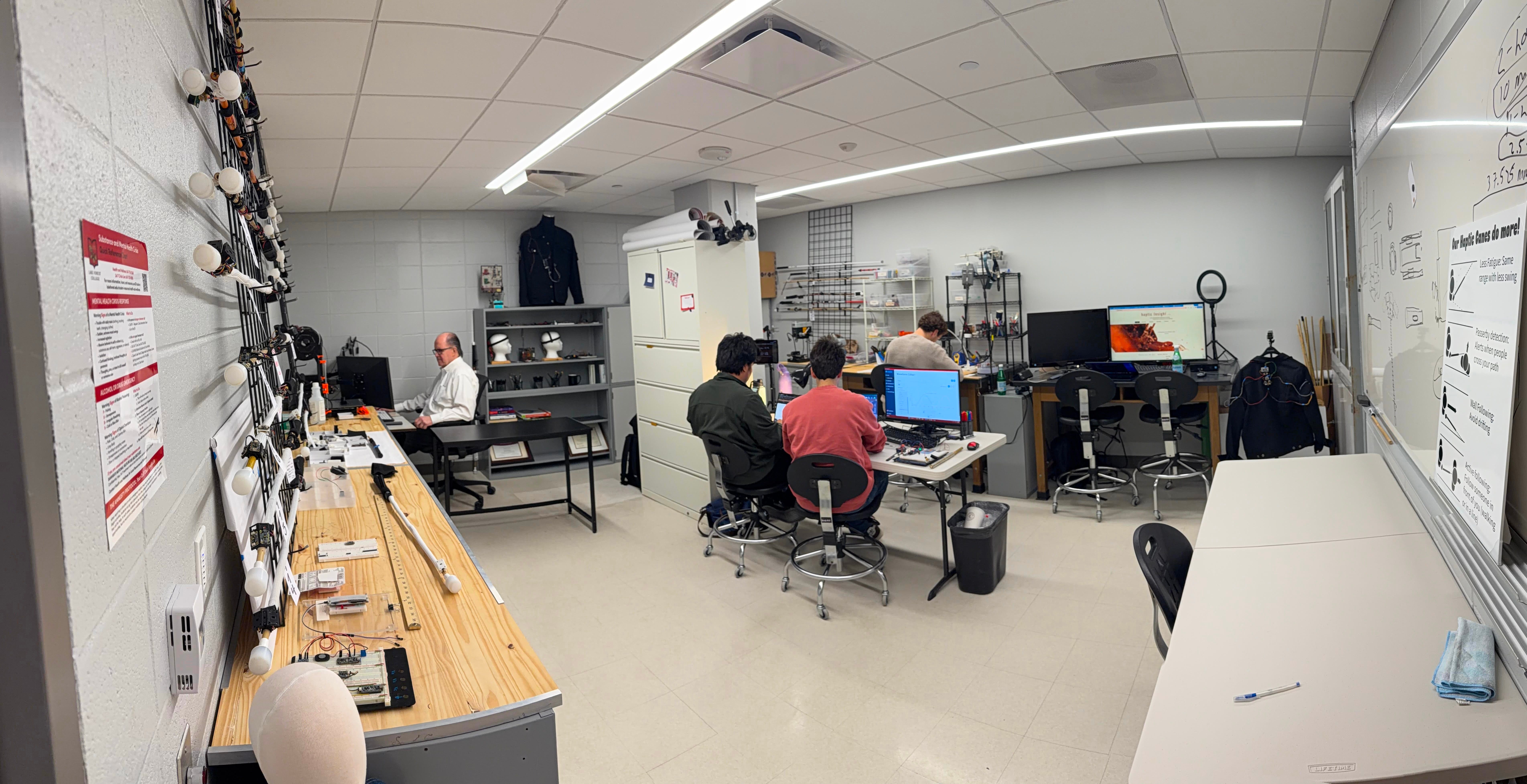
First, Lake Forest College, at which I was teaching as a Visiting Assistant Professor, offered me laboratory space in their recently remodeled science center. Although they could not support my research financially—that was still up to me—it allowed me to move my laboratory from my basement into a vibrant academic community. In return for the space, I would provide real-world, transformative research opportunities for the undergraduates. It was truly a win-win arrangement.
The second event—the not-so-good part—was that as our research gained momentum, so did my vision loss. And soon, ironically, I was reliant on the haptic-enhanced white cane that I had developed.
Vision loss is annoying, to be sure. But, as any member of the National Federation of the Blind will attest, it’s more of an inconvenience than an impediment, and it doesn’t define us as people. In fact, there are literally thousands of companies and organizations run by members of the blind and low-vision community. So my research goes on.
There’s another irony here, too. As I lost more of my vision, I began to “see” my research from a perspective that had been invisible to me when I was fully sighted. It’s a bit difficult to explain, but the world is quite different when you can’t see it than it is if you’re a sighted person wearing sleep shades. So testing our products, evaluating ideas, and designing our technologies became more nuanced, compelling, and heartfelt. In short, without sight, I saw my mission more clearly.
It’s no longer a pipe dream. It’s not a bunch of wires and computer chips on my workbench anymore. It’s an integral part of my life. It’s a bit of comfort, some additional security, and a testament to my research students’ teamwork. Now, in the spirit of charity and goodwill, we would like to make these canes available to other members of the blind/low-vision community.
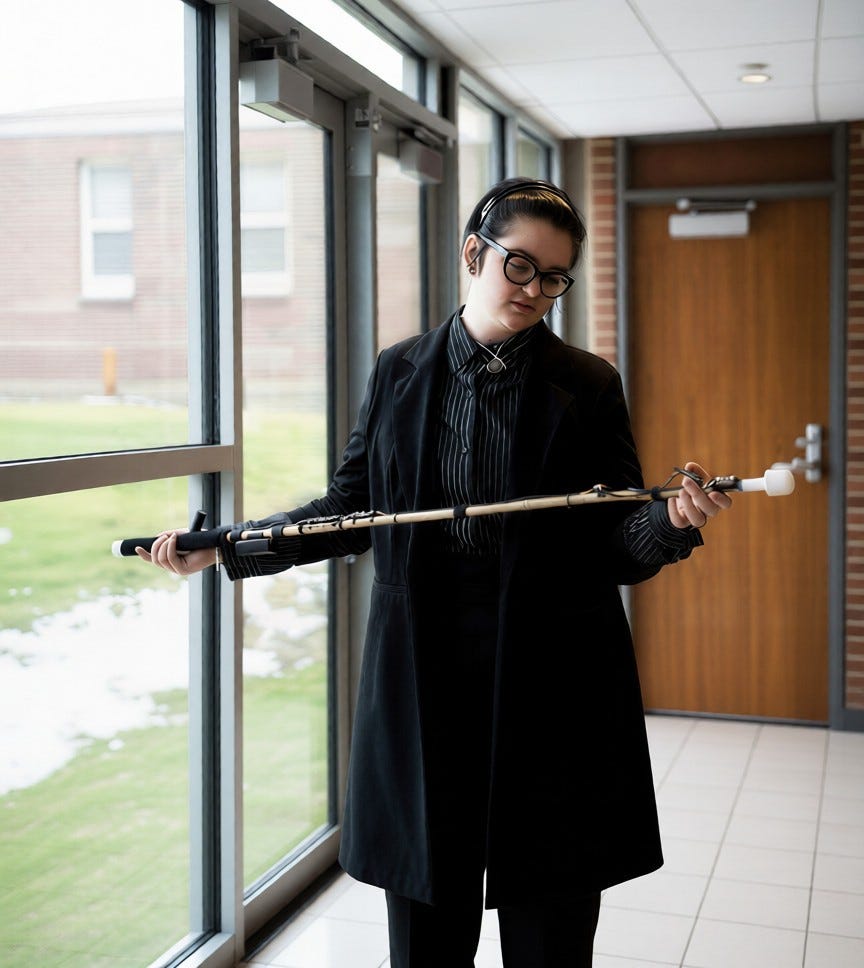
So we took a few prototypes to the Illinois State Convention of the National Federation of the Blind to get some informal feedback. The response from people who tried them was overwhelmingly positive. I was especially struck by two individuals: a 12-year-old student, blind from birth, who was absolutely fascinated by the technology, and a middle-aged engineer, recently blind, who was thrilled by the idea that our cane would allow him to navigate around his house without accidentally striking his daughter with the cane tip.
Encouraged by these responses, we recently displayed several prototypes at the national convention of the Association for the Education and Rehabilitation of the Blind and Visually Impaired (AER). Again, all of the feedback that we received from orientation and mobility teachers, other professionals, students, and clients was positive, and many asked for prototype canes to evaluate. It was all very exciting.
The Ask
Haptic Insight is still a not-for-profit, charitable venture funded primarily by me. However, as a single person, I can only do so much. To take this project to the next level and start supplying haptic-enhanced white canes to all those who have asked for them, we need some help. So, like all other charitable startups, we have been seeking donations from our friends and colleagues.
Then it occurred to me that you might want to help, too. If you’ve been reading along for a while, you know this isn’t just a project to me. It’s a deeply personal and passionate commitment to other members of the blind and low-vision community.
If you decide to contribute, here’s the important part: every dollar goes directly to the work. Donations are made through Lake Forest College—that’s what makes your donation tax-deductible—and it is placed into a dedicated research account for the Haptics Lab. None of it goes to me personally. None of it is used for administrative salaries or overhead. It goes into parts, sensors, motors, batteries, handles—the actual materials that become canes.
Right now, we are building and distributing these haptic-enhanced canes free of charge to blind and low-vision users, including students with special needs. We want them using the cane in real environments, the way I use mine—so we can keep improving the design and, more importantly, so it can start improving lives now.
In practical terms, every $150 we raise buys the materials for one more cane.
That’s it. It’s simple. One more cane in someone’s hand. One more person moving through the world with a little more information, a little more confidence, a little more independence. And honestly, if just half of my readers chose to give a recurring $5 a month—or even made a single $50 donation—it would fund our work for an entire year. That’s roughly the cost of one Substack subscription.
If you’d like to help make that happen, I’d be deeply grateful. You can click HERE to reach the Lake Forest College Haptics Lab donation page. Note that the designation field says “Prete Lab.”
Thanks.
Epilogue
I got lost taking the garbage can down to the curb a couple of weeks ago. Sounds weird, doesn’t it? It had snowed the night before, so everything was blanketed in white, and I got disoriented at the end of the driveway. I ended up in front of my neighbor’s house looking for my back door. Luckily, he was home and kindly walked me back over to my house. If I were the kind of person who gets embarrassed, I would’ve been mortified. I just took it in stride, but it was just one more humbling experience.
When I write and teach, I frequently talk about the fact that intellectual humility is the key to learning. Compared to what there is to know, each of us knows very little, and most of that is probably wrong. Now nature’s found yet one more way to keep me humble. I no longer have those subtle, nuanced visual cues on which sighted people unconsciously rely, cues that I took for granted for virtually all of my life. Now I have to relearn the world from scratch, as it were.
I’m also more reliant on the kindness and understanding of others, to a degree and in ways that I could not have imagined when I was fully sighted. I’m humbled by that, too—and deeply grateful to those who are kind enough to help me.
What a positive article to read about your lab and students. Thank you!
I have been supporting Guide Dogs For The Blind for many years, but of course, not every person with low vision is able to have a guide dog (for many reasons). Your haptic cane will fill a much-needed niche, as you will know! That is why I am happy to donate to your research.
And I love your Substack!