
Melatonin Doesn’t Control Sleep (part 2)
...and you can’t either
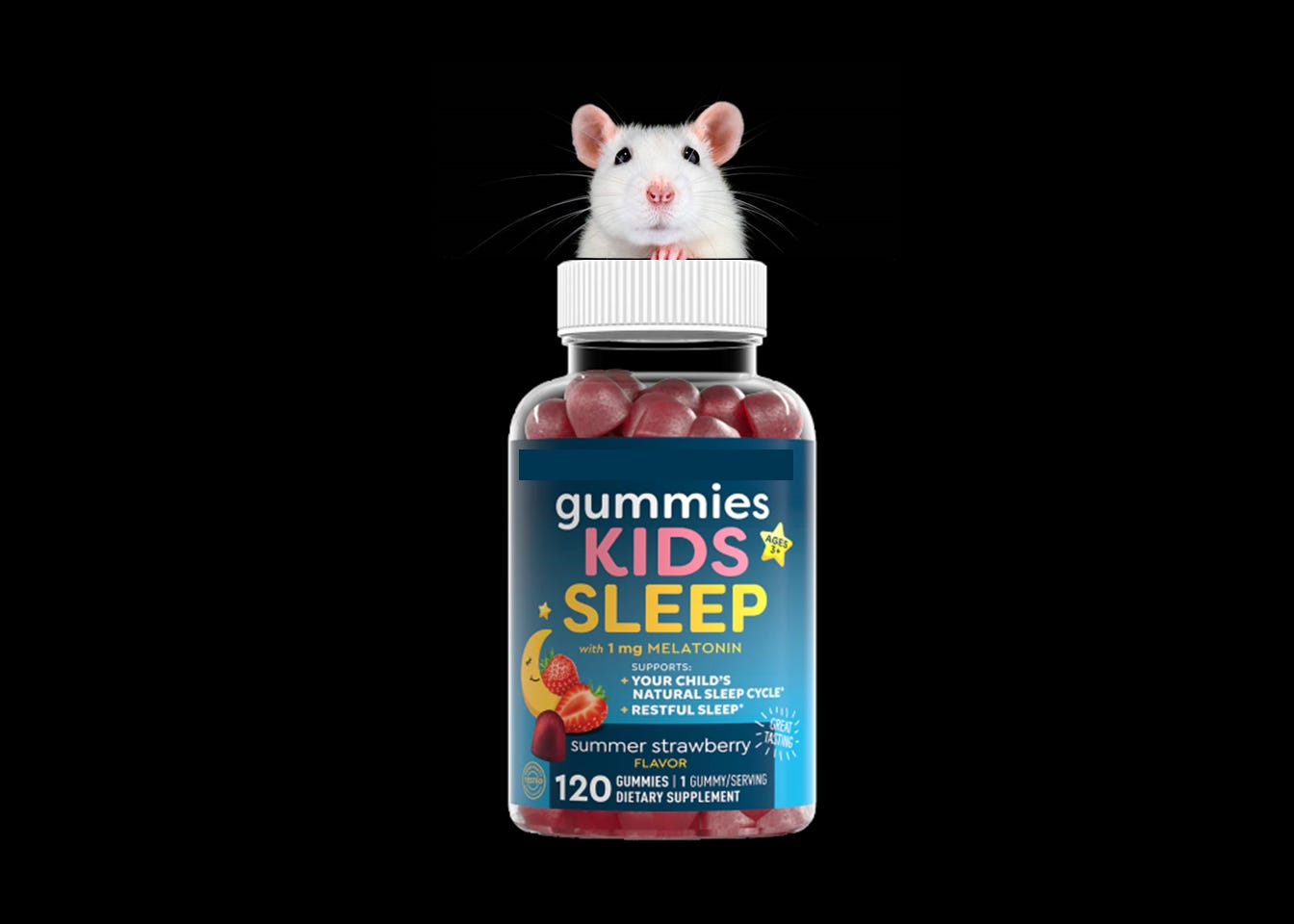
After I wrote that essay about melatonin, I thought I would get to this one much sooner. However, sometimes life scrambles our plans and sends us down unexpected pathways… In fact, that’s how I ended up working in a sleep research lab in the first place.
Due to a series of serendipitous events, I was accepted into, and spent my first couple years of grad school working in Prof. Allan Rechtschaffen’s sleep research laboratory at The University of Chicago. We were studying the effects of sleep deprivation on physiology using the ubiquitous white rat as a model system.
Because of my background in psychology, I was interested in the relationship between sleep and the brain’s ability to coordinate physiological systems, especially those involved in thermoregulation. It was interesting work, indeed.
However, as much as I’m fascinated by brains, I’m not that crazy about rats. So, after getting a couple papers published, I left the lab to study vision. But, that’s another story.
Despite my feelings about rodents, I must admit that those rats taught me a lot about sleep and, for that, I am grateful.
Of all lessons learned from those little creatures, the most important was that sleep — like many other biological phenomena — is an emergent property of the physiological rhythms inherent in all living systems. As such, it has no discrete control mechanism or ‘on-off’ switch (like a hefty nighttime dose of melatonin).
At first, that was difficult for me to understand. It’s easier to think of our bodies in simple, mechanistic terms. So, it took a good bit of research and some hard thinking to make sense of sleep. Eventually, though, I think I got it.
Basically, there were three principles that I had to learn in order to understand sleep. The first is that all physiological systems oscillate rhythmically. The second is that biological oscillations spontaneously synchronize. And, the third is that environmental cues — like light or temperature — can entrain (but do not control) the rhythms so that they roughly match the 24-hour day. The sleep/wake cycle — which is an oscillation between activity and inactivity, or, in some animals, between consciousness and unconsciousness — emerges from those rhythms.
Rhythms
You probably learned about homeostasis in psychology or biology class, and your instructor probably made an analogy between a thermostat and a hypothetical ‘control center’ that tries to keep your bodily processes at some predetermined ‘setpoint’.
Although most instructors (and textbooks) still use that model, it’s misleading and pretty outdated. It’s traceable back to 19th and early 20th century physiologists Claude Bernard and Walter Canon, and to mid-20th century mathematician Norbert Wiener, all of whom considered biology to be much more mechanistic than we now know it to be.
The truth is that none of the systems in your body remain at some ideal steady-state. They all oscillate up and down. Depending on the system, the oscillations can be rapid (hundreds of times a second), or very slow (over days, months, or seasons), and they occur at all levels of analysis from molecules to entire populations of organisms. For example, the cardiac pacemaker cells that trigger your heartbeat spontaneously create bursts of electrical current about 60-100 times per minute, and the rhythmic activity of your brain’s respiratory centers keep you breathing at about 14 cycles per minute. Your circulating insulin levels oscillate at both high (6–10 min) and low frequency periods (140 min). Other hormones may oscillate on a daily (cortisol), or monthly cycle (follicle stimulating hormone). In contrast, some physiological oscillations are quite long, for instance, the seasonal fluctuations of reproductive hormones in animals that breed just once a year, or the physiological (hormonal) oscillations that trigger seasonal bird migrations. In fact, physiological oscillations are so fundamental that their appearance marks the very beginning of human development: Mammalian eggs are activated by intracellular calcium oscillations that begin just after fusing with a sperm.
If the period of an oscillation is about 24 hours, it’s called circadian. If it persists on its own (without any external time cues), it’s considered an endogenous rhythm. Such self-sustaining, endogenous circadian rhythms have deep evolutionary roots in all groups of organisms from bacteria and fungi to plants and people.
In humans, oscillations in thirst, appetite, digestion, temperature, kidney and cardiovascular function, gut microbiota metabolism, blood pressure, glucose and lipid metabolism, the production and release of hormones, and, of course, the wake/sleep cycle are examples of endogenous circadian rhythms.
But, there’s more to the story. All of these daily rhythms are actually the higher-level behavioral and physiological expressions of spontaneously oscillating gene activity going on in individual cells. Those details are more than we need here, but suffice it to say the lower-level molecular oscillators — think of them like metronomes — exist in cells throughout your body including your brain, liver, muscles, fat cells, and virtually every other tissue examined. Each of these molecular metronomes is like a musician in a symphony orchestra. Each musician plays their instrument independently, but each influences, and is influenced by the pattern of sounds produced by the musicians around them.
Obviously, all of these oscillating systems — from molecules to whole organism behavior — have to be coordinated in some way, and indeed, they are, but not by a central command system. They become organized via spontaneous synchronization.
Although it’s difficult to believe, interacting oscillating systems can fall into synchrony all by themselves without any ‘master’ controller. You’ve experienced this if you’ve ever heard the random applause of an audience spontaneously become a coordinated pulse, or seen the random flashes of fireflies gradually transform into synchronized, rhythmic waves of light. A more dramatic example is the spontaneous synchronization of metronomes set to different frequencies when they’re placed on an unstable platform that allows them to mechanically interact. Then, when they’re placed back on an immovable platform, they spontaneously desynchronize. You really can’t believe this until you see it… So, watch this 2-minute video.
As with the metronomes, independently oscillating biological systems synchronize not because there’s a single central controller but because the independent oscillating systems influence each other like the metronomes on the swaying platform. In your body, the interactions — which lead to a phenomenon called ‘coupling’ — are a result of electrical and, chemical interactions from the cellular to the systems level of analysis.
To return to the orchestra metaphor, we know that orchestras can play without a conductor. The dynamic interactions between, and organization among the musicians is sufficient to keep the music intact. However, what if you wanted to speed up, or slow down the spontaneous tempo a little bit? Then, you would need a conductor.
Entrainment
Interestingly, we have little molecular metronomes (biologists call them ‘clocks’) inside our cells that affect both their own local physiological rhythms, and those of the tissue and organ systems of which they are a part. And, miraculously, they do it all without a boss. However, no organism — including you and me — can be understood in isolation. You are embedded in an environment both evolutionarily and developmentally. That environment affects your physiological rhythms, too. It does so by nudging the rhythms slightly away from their free running period and closer to a 24 hour cycle. Without those cues, the normal adult ‘circadian’ rhythm runs a bit longer, about 25 hours.
For animals in an aboveground, terrestrial environment like you and me, the primary environmental timing cue for our circadian rhythms is light. Under normal circumstances, this would be sunrise and sunset which, of course, change with the seasons and location on the planet.
Light cues affect your circadian rhythms via a visual pathway that projects to several brain areas including a structure called the suprachiasmatic nucleus (SCN), which is two small clusters of about 10,000 cells in your hypothalamus — roughly in the middle of your brain.
Although the SCN’s cells have their own molecular rhythms, incoming light influences their activity which, in turn, influences most of the behavioral and physiological circadian rhythms in your body. However, the SCN is also influenced by as many as 40 other brain areas. One of these is a series of structures called the raphe nuclei which, themselves, are necessary for normal sleep-wake cycles and release the neurotransmitter serotonin into the SCN. During the daytime, serotonin activates the SCN pacemaker cells, and at night, it inhibits them. In other words, non-photic (non-light) stimuli such as sleep states, themselves, can influence SCN activity.
The SCN produces several chemicals important in maintaining circadian rhythms. Some of these increase during the daytime, and some increase at night. One of these (vasoactive intestinal peptide) maintains the SCN’s internal synchronization. Others (such as arginine vasopressin), coordinate circadian feeding and drinking patterns (as in you tend to get hungry at specific times during the day, and mice drink a lot of water right before they go to sleep).
Cells in the SCN send long projections (axons) to a variety of other brain areas one of which is the preoptic nucleus of the hypothalamus, a structure that’s essential in coordinating sleep-wake cycles and thermoregulation (control of body temperature), which, by the way, are tightly interconnected.
But you have to remember that the SCN isn’t a dictator. It’s a conductor that influences the activity of thousands of rambunctious musicians. For instance, you can stay awake all night or go on a three day fast overriding all of your normal physiological rhythms. You can travel somewhere with the opposite daylight cycle or work the night shift. You can change the times of day at which you eat which will affect the cellular clocks in your liver. Conversely, the time that you go to bed and wake up will influence the times at which you eat.
Consequently, circadian rhythms are the integrated output of a network of different clocks and rhythmic factors organized hierarchically, strongly influenced by their conductor, the suprachiasmatic nucleus.
The melatonin connection
The SCN sends most of its output information to the pineal gland, a small, unpaired endocrine gland that produces melatonin. Evolutionarily, this structure started out as a third, upward facing eye whose job it was to sense light/dark changes in the environment. It still exists as a third, light-sensitive eye in a number of reptiles, amphibians, and fish. In you (and other mammals), it’s evolved into a melatonin producing gland that gets information about light/dark cycles from the SCN. And, as you know, melatonin production is stimulated by darkness and inhibited by light. (That’s how it got mislabeled as a control mechanism for sleep.) Consequently, it serves as one of many hormones that oscillate in response to light/dark cycles.
As I noted in Part One, melatonin has wide ranging physiological effects. It plays a role as a signaling mechanism in the coordination of peripheral circadian clocks in the lung, liver, kidney, heart, and muscles all of which manifest circadian gene expression based on the combination of photic (light) input to the SCN and non-photic factors such as the timing of food intake or motor activity. In short, the expression of circadian rhythms depends on the integrity of the SCN’s rhythmicity, and on the integration of thousands of individual cellular clocks throughout the body. This integration requires a number of hormones and neurotransmitters at all system levels: at the input, in the SCN, itself, and in its output in order for the whole system to function properly. Melatonin is just one of those hormones.
Hey, Frederick, my kid won’t go to sleep!
Yeah, I get it. When I was a stay-at-home dad, I had to get three little ones to sleep every night, and some nights the kids had difficulty dozing off. After twelve or thirteen hours of innumerable diaper changes, meal preparation, refereeing squabbles, hours at the park, trips back and forth to preschool, and tender moments reading storybooks while all cuddled up on the couch, bedtime could seem like one more, nearly insurmountable challenge for an exhausted grown-up. But the answer isn’t reaching for a bottle of hormones. Maybe the answer lies in all of that biological mumbo-jumbo.
So, let’s unpack some of this. None of the biological facts that I have described are important in and of themselves. My purpose in explaining them was to make the point that sleep is not a simple process with a single causative mechanism. Rather, it is a collection of interacting processes that exist within a particular physiological and environmental context. Likewise, sleep probably does not exist for one particular reason. That is one reason why, after decades of research, scientists still debate exactly why organisms sleep. Sleep is not a thing unto itself so much as an emergent property of biological organization.
This is why the most effective ways to address ordinary sleep difficulties are often surprisingly mundane. Sleep researchers refer to these practices collectively as sleep hygiene. The term sounds vaguely medical and a little dull, but it simply means arranging your daily habits and environment in ways that allow the brain and body to do what they evolved to do.
That means going to bed and getting up at roughly the same times each day, because the nervous system thrives on regularity. It means creating a bedroom environment that is cool, dark, quiet, and associated with sleep rather than work, television, social media, or other stimulating activities. It means limiting caffeine late in the day, avoiding heavy meals and alcohol close to bedtime, getting regular physical activity, and exposing yourself to daylight during the day so that the body’s internal clocks remain synchronized with the outside world. It also means developing a predictable bedtime ritual—a warm bath, a book, quiet conversation, soft music, or whatever else helps signal to the brain that the day is winding down and sleep is approaching. In short, good sleep hygiene works because it provides the physiological systems involved in sleep with consistent environmental cues. Those cues help coordinate the many interacting mechanisms that must come together before sleep can occur.
Notice that none of these recommendations relies on a single “sleep molecule” or a magical switch hidden somewhere in the brain. They work because sleep emerges from the coordinated activity of countless physiological systems responding to internal and external signals. Sleep is not something that happens because one thing causes it. It is a process that emerges when many things are working together.
And, of course, because sleep is the product of the integration of innumerable physiological systems, it takes time for those systems to mature in an infant and become entrained to the rhythm of the day. Newborns do not arrive with fully developed circadian rhythms. Over the first months and years of life, biological clocks, hormone systems, patterns of feeding, exposure to light and darkness, and social routines gradually become coordinated. Sleep patterns are not so much installed as they are assembled. Consequently, one of the most effective things parents can do is provide a regular pattern to the day. Consistent times for meals, activity, exposure to daylight, quiet periods, and bedtime help these developing systems fall into place. The goal is not to force sleep to occur but to create the conditions under which it is most likely to emerge naturally.
That brings us back to the original question: “Why won’t my kid go to sleep?” The frustrating answer is that there is probably no single reason. Sleeplessness is not like a machine with one broken part. It is a biological symphony involving the brain, hormones, metabolism, body temperature, environmental cues, development, experience, and behavior. Understanding that complexity may not make bedtime easier tonight, but it does remind us why simple explanations—and simple cures—are so often disappointing.
Epilogue
Eat. Poop. Pee. Sleep. Four of the most basic biological functions. In fact, they are so physiologically compelling that you cannot ultimately prevent an organism from doing any of them. Yet, ironically, they seemed to be the obsession of nearly every stay-at-home (or primary-care) parent I met during the years that I was at home raising my children.
Most of the conversations that I overheard in the halls of the preschool building, on the playground, or among the room parents revolved around conflicts over their inability to control these bodily functions in their kids: they couldn’t get them to eat healthy food, couldn’t seem to toilet train them, or couldn’t get them to go to bed.
Do you see the inherent problem here?
Sometimes parents mistakenly believe that they can control their child’s physiology despite the fact that, in virtually all cases, they have little understanding of the biology over which they seek dominion. Hence, the unending battles.
The solution, of course, is the same solution we should apply to all things biological: compassion, understanding, a dash of emotional intelligence, and an attempt to appreciate the fascinating intricacies of the people we love.
You can’t expect a child to go to sleep at a particular bedtime without first creating a sleep-conducive environment. You can’t “toilet train” a child — a phrase that I’ve always disliked — who is not yet physiologically capable of voluntary control. And you can’t expect a kid to enthusiastically eat vegetables at dinner if the rest of the day is filled with junk food, soft drinks, and potato chips.
It’s not rocket science. In fact, it’s mostly common sense.
Having worked for years as a midwife on rotating, rostered shifts, I have no problems with understanding the bodily upset to an ever-changing sleep schedule. For years, my sleep hygiene was pretty dirty; in fact, it took three years post-retirement before I realized that I now had a "normal" sleep/wake pattern and didn't feel constantly fatigued.
As a breastfeeding mother of three, who were mothered similarly, I can speak to the individuality of children. My children hit that golden moment of sleeping through the night at three months old, three and a half years old and 18 months old. Now all adults, they are clearly three individual personalities!
I am also left wondering how totally destroying normal physiology by administering cross sex hormones is affecting cognitive functioning in those who identify as transgender.
Wonderful explanation about how an emergent property occurs. And just how important patterning is for childhood development... in this case, sleep. I did a little experiment in my primary classes between the student's height and typical amount of sleep and discovered there was a fairly reliable indicator between shortest kids compared to their taller peers based on the amount of sleep regularly obtained. Not causal, of course, but a pretty strong correlation.